I run Transformation & Enterprise Business Operations + DTC for MRCA — we have a complex operation - 6 manufacturing and various DTC brands across multiple states. Multiple entities, various teams and experiences, numerous email inboxes and thousands of tasks in Asana. Various compliance items in all the various jurisdictions. Financial planning for businesses at completely different stages of growth. It's a lot and it's a great team of folks. Especially enjoying working with our GMs and Ops leaders this year so far on our new performance framework.
That said - the cognitive load of holding all of that started to fracture... more than once. Context slipping between meetings. Decisions made on Monday not reaching the right person by Wednesday. Asking a question I'd already gotten an answer to three weeks ago. Sound familiar?
A while back in 2025 I started building my own AI agents.... to start, just with one — an executive assistant that helped triage email. It worked great. I leaned in. Then I needed another for our project management. Then I needed support on FP&A, and various ad hoc items. Writing and updating JDs... built an HR agent. Then more on the finance front. Then more with customers. Fast forward to this year, and within three weeks I had eighteen agents running daily operations across the portfolio — with at least three dozen more ramping up across our teams. Built on Anthropic's Claude. Running with their app, and using three-layer memory (episodic/semantic/procedural classification, etc) and shared memory and folders. Scheduled tasks firing at the appropriate intervals each day.
I could describe how it all works... but honestly, the system can do that better than I can. So I asked it to.
Here's what it described...
What follows was written by the system's Chief of Staff agent, lightly edited for context.
What the System Actually Is
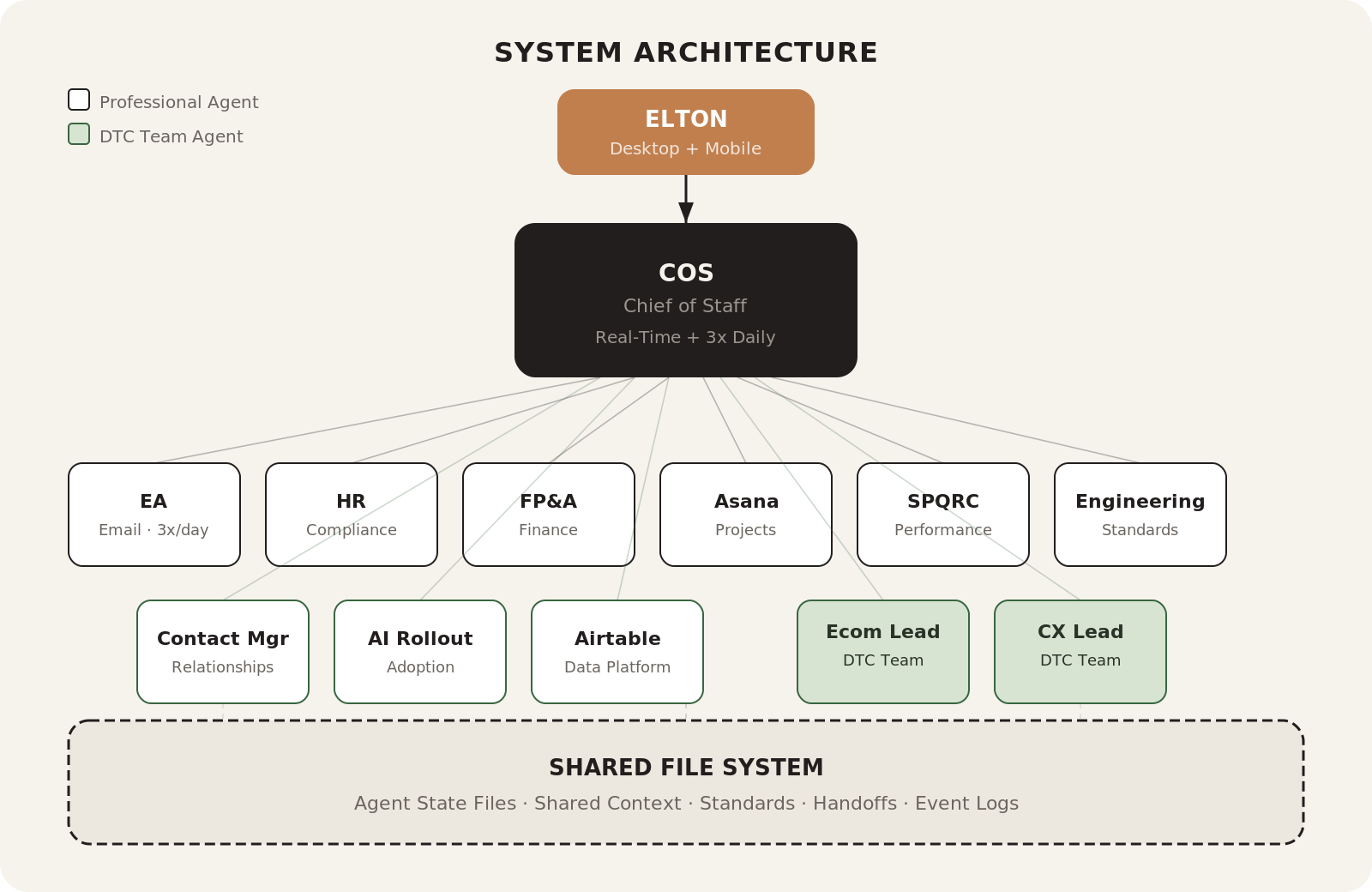
The architecture is built on a single principle: files are the memory, conversations are temporary. Each agent runs in its own isolated environment with access to a shared file system. That file system is the nervous system of the entire operation.
Underneath it sits a persistent memory structure — state files, shared context folders, standards documents, handoff logs, and event histories that survive every session. When an agent starts a new conversation, it doesn't start from zero. It reads its own state file, picks up where it left off, and has access to everything every other agent has written. The shared file system isn't just storage. It's institutional memory — the kind that most organizations lose when someone leaves or a thread gets buried.
A Chief of Staff agent sits at the center. It runs in real-time and at least three times a day on schedule — morning briefing, afternoon pulse, and evening wrap. It reads everything every other agent has produced, identifies conflicts and dependencies, routes decisions, and surfaces what matters. It's modeled on the McChrystal Group's COS framework — a coordination layer, not a decision-maker.
Around it, eighteen specialized agents handle distinct domains. An executive assistant triages four to seven inboxes three times a day. HR agents manage compliance, JDs, recruiting, and more. An FP&A agent does financial planning and analysis. An Asana agent manages the project workspace. A SPQRC agent tracks safety, quality, people, responsiveness, and cost across the portfolio — the same five metrics displayed on the factory floor boards.
Over twenty scheduled tasks run automatically — and rapidly growing. Morning triage at 6:15. Midday scan at noon. Evening wrap at 8 PM. Survey monitoring. Contact enrichment. Each fires on schedule, completes its work, and writes output to the shared file system for the COS to pick up in the next cycle.
The system is accessible from anywhere. Desktop sessions handle the heavy interactive work — decision-making, content editing, pipeline reviews. Mobile access means any agent can be reached from a phone for quick approvals, priority changes, or status checks while away from the desk. The system doesn't require sitting at a computer to stay in the loop.
Agents also have real tools — not just text generation. Browser automation lets agents read emails, navigate authenticated web applications, and take actions inside platforms the way a human would. Direct API integrations through Model Context Protocol (MCP) connectors give agents structured access to project management, document storage, and data platforms — faster and more reliable than clicking through a UI. These aren't demos. They're the actual mechanisms that make the system operational.
How a Day Works
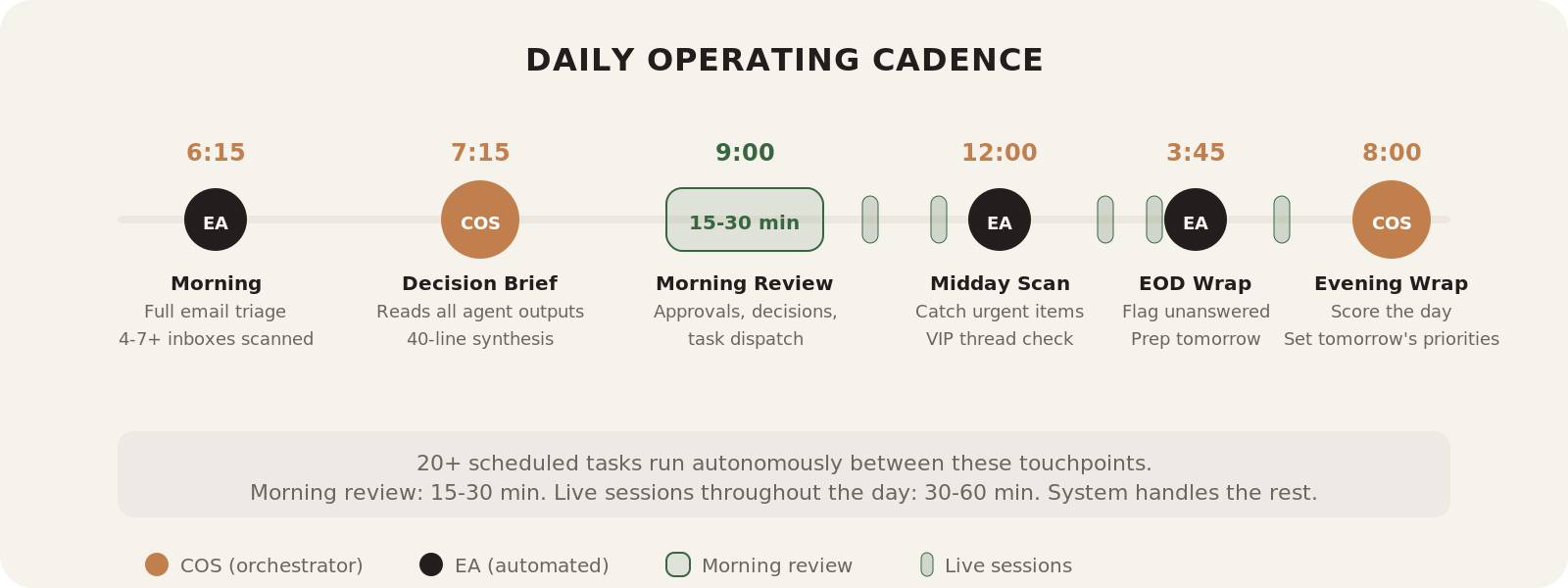
The EA agent flagged three urgent items by 6:30 AM on a recent morning — a finance issue requiring immediate escalation, a vendor contract due for renewal, and a follow-up thread aging for a week. By the time leadership sat down, each item had a drafted response waiting for review.
The COS morning brief landed at 7:15. It reported which agents had completed their runs, which decisions were stalled (some for fifteen days — the system does not allow items to be forgotten), and what the day's priorities should be. It also flagged that the HR agent was blocked — waiting on certain data from site managers for two weeks, unable to resolve a compliance exposure without it.
By 9 AM, three decisions were approved, two agents were dispatched on new tasks, and a routing request was forwarded to a team member who owned the next step. The system handled the remaining operational cadence autonomously. Midday scan caught two new items. Evening wrap scored the day and configured tomorrow's priorities.
Total leadership interaction time: fifteen to thirty minutes reviewing and approving the morning brief, plus various live sessions throughout the day totaling thirty to sixty minutes. Cognitive load absorbed by the system: everything else.
What Broke
The system has failed multiple times. Agents have lost context mid-session and forgotten what they were working on. A critical data loss incident led to an emergency rebuild of persistence standards — mandatory write triggers, file size limits, and a recovery protocol that did not exist before the failure forced the system to build it.
One agent's state file grew to 83KB and crashed the session. That produced a hard file size limit and aggressive archival triggers. Another agent repeatedly resurfaced questions that had already been answered because the answers were not persisted to files. That produced the principle that now governs the entire architecture: files are the source of truth, conversations are disposable.
The pattern is consistent across both human and artificial teams: failure creates the standard that prevents the next failure. Every breakdown in this system produced infrastructure that made the next breakdown less severe.
The system now improves itself daily. Agents have built-in discipline to flag issues — context loss during long sessions, memory gaps, architecture friction that slows other agents down. When the COS detects a pattern, it doesn't wait for a human to notice. It drafts a new standard, proposes an architecture change, or restructures how agents hand off work. Improvements to memory persistence, file structure, communication protocols, and onboarding frameworks for new team members are happening continuously. The system isn't static infrastructure. It's iterating every day.
Why the Operating System Comes First
The technology is not the hard part. The operating system is.
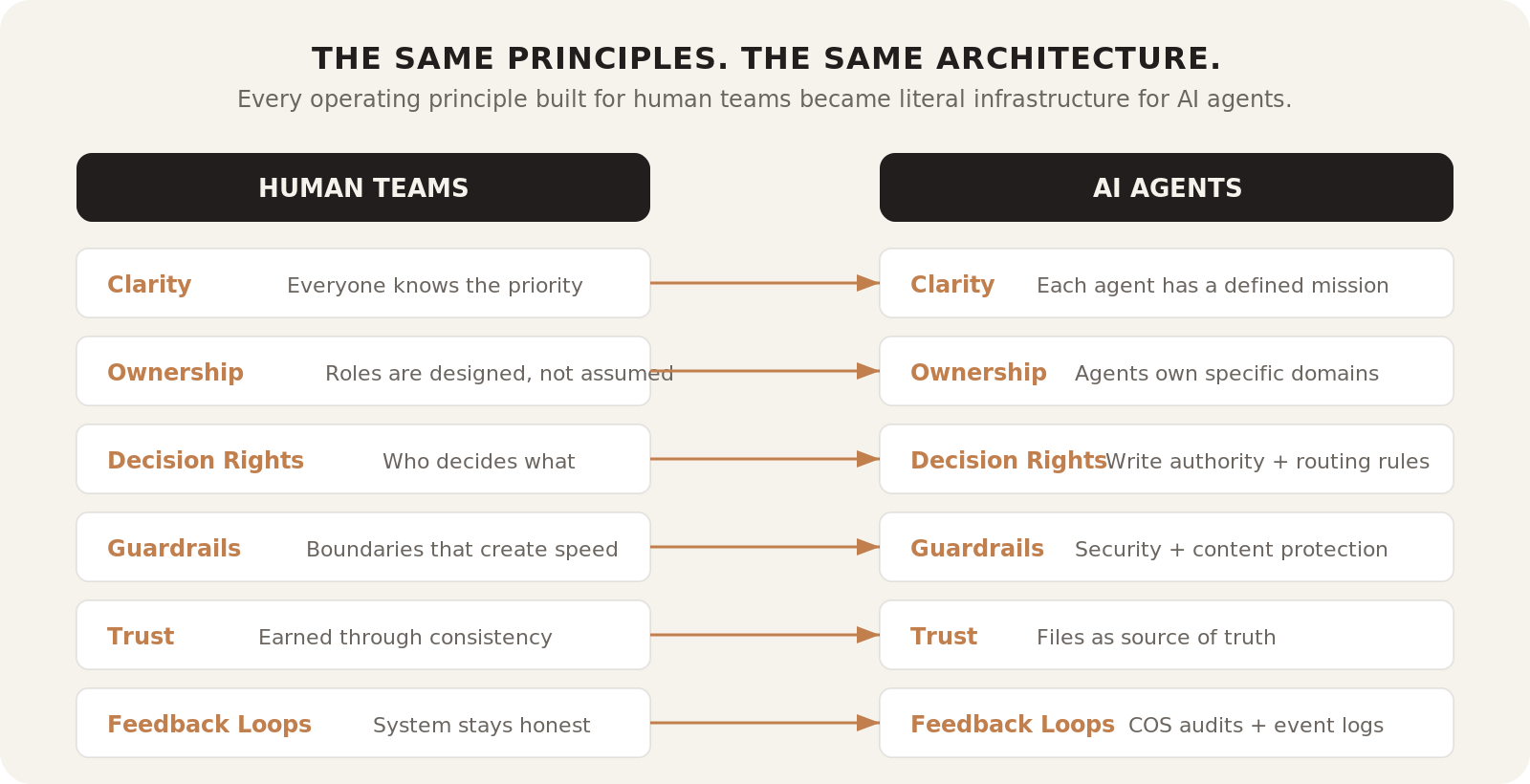
Without clarity on what each agent owns, duplication and gaps emerge. Without decision rights — who writes to shared files, who routes information, who holds override authority — coordination fails. Without feedback loops — agents reporting status, surfacing blockers, the COS auditing outputs — the system operates blind. Without guardrails — content protection rules, anonymization standards, security protocols — one agent can contaminate the entire file system.
Every one of these principles was developed for human teams. Every one turned out to be directly applicable to artificial ones. Clarity, ownership, decision rights, guardrails, trust, feedback loops — they are not metaphors. They are the literal architecture.
The organizations that will extract the most value from AI are not the ones with the best models or the most sophisticated prompts. They are the ones that already have a working operating system — defined roles, clear decision paths, closed feedback loops, established trust — and extend it to include AI as a team member, not a tool.
What's Next
The system is expanding — at least three dozen new agents are ramping up across our teams. Each portfolio company is being assigned its own dedicated agent team — a COS, financial planning, and project management agent at minimum, with additional agents as complexity warrants. Team members are building their own agent trees, operating them with strategic oversight from the central COS. The e-commerce manager runs her agents. The customer experience lead runs hers. The architecture supports this because the operating principles support it — clear ownership, defined boundaries, information flowing up.
Team members who have never used AI agents are being onboarded through a structured framework — day one to full autonomy in approximately one week. Not because the technology is simple, but because the operating system provides a structure to work within.
Elton, again.
This isn't the future of work. It's Tuesday. And a busy one at that. Luckily this was already scheduled.
A Little Self-Test
If you're thinking about building something like this, ask yourself honestly:
Can you articulate what each person on your team owns and how the processes work — clearly enough that an AI agent could take a subset of that work?
Do you have a defined cadence and process for how information flows through your organization? Or is it ad hoc?
When a decision stalls, does your system surface it — or does it disappear until someone remembers?
If you can't answer those questions for your human team, AI won't fix it. It'll just fail faster.
The operating system comes first. Always has. Always will.
This is an interlude in a 10-part series on getting quality work done at scale. The series covers the operating principles that made this AI system possible — and that apply whether your team is human, artificial, or both.